
You must leave Canada immediately!


Theresa, a citizen of Saint Lucia, entered Canada as a visitor nine months ago. After staying in Canada for five months, she applied for an extension of her stay as a visitor. However, an officer refused her application. Theresa’s refusal letter included this sentence: “You must leave Canada immediately.” Is this a removal order, Theresa wonders?
Table of contents
The “you must leave” phrase for applications to remain in Canada
Sometimes you apply to stay in Canada as a visitor, worker, or student. However, if the officer refuses the application, they may ask you to leave Canada as soon as your current status expires. Of course, if you are on maintained status, you lose it upon receiving the refusal. Here is a typical letter of this nature:
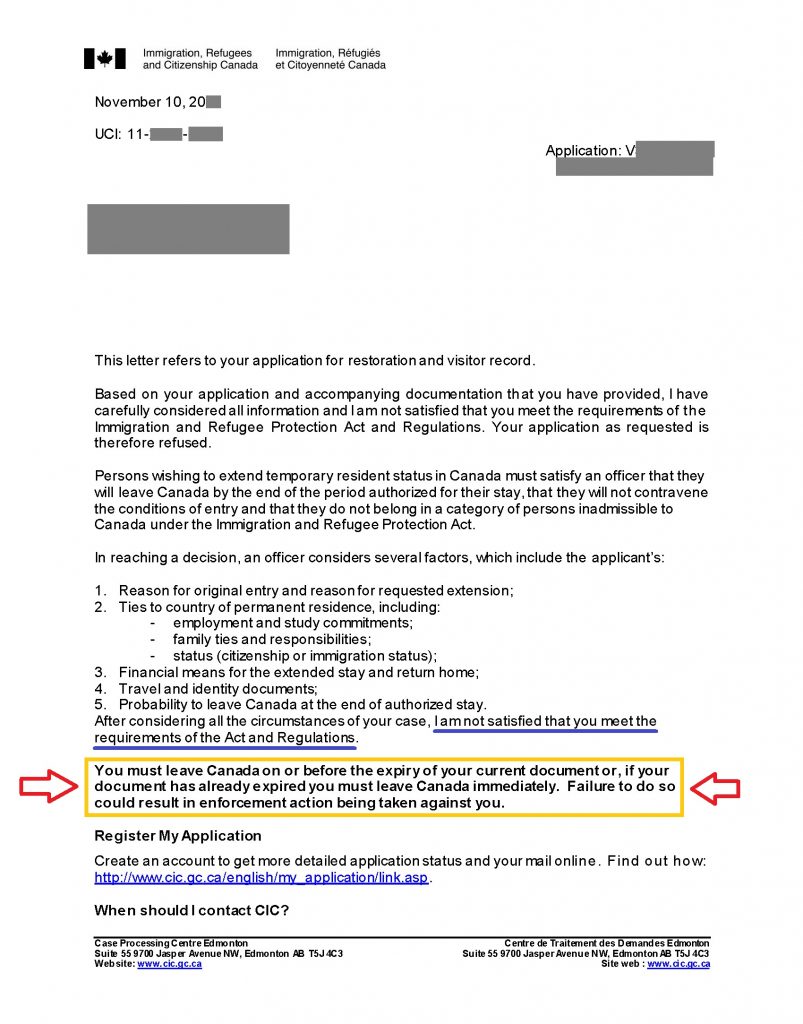
Generally speaking, this is not a removal order. However, you must take one of the following actions as quickly as possible:
- Leave Canada; or
- Apply for the restoration of status.
Overstaying in Canada could result in an exclusion order. CBSA is the entity that usually issues such orders.
The “you must leave” phrase at the port of entry
At the port of entry, you are subject to examination. If the officer realizes they cannot allow you to enter Canada, they may take any of the following actions:
- Ask you to leave voluntarily by signing the Voluntary Departure form
- Send you back to the United States
- Issue you a removal order
- Detain you
Of course, the last one is a harsh decision that they could take under exceptional circumstances. Although the first two options ask you to leave Canada immediately, they are not removal orders.
When you receive a removal order
If you receive a removal order you do not necessarily need to leave Canada immediately. Here are some potential alternative options:
- The removal order may allow you to remain in Canada for a few days. For example, departure orders usually allow you to remain in Canada for up to 30 days. However, you must leave Canada within the 30 days duration and report your departure to CBSA. Otherwise, your departure order becomes a deportation order.
- You could ask CBSA for a PRRA form. Of course, you may do so if you claim your life is in danger in your home country. By submitting a PRRA application, your removal becomes unenforceable.
- By filing for judicial review (JR) your removal order becomes unenforceable. However, it becomes enforceable as soon as you lose the JR application.
- If you have the right to appeal, you may appeal the decision and remain in Canada while IAD reviews the application.
Let us help!
If you have received a letter that reads you must leave Canada immediately fill out the following form. Alternatively, you may book a consultation session with me. If you are a licensed practitioner please book a mentorship session with me. For all other circumstances, you may fill out our assessment forms.
Read this in Spanish


If you are interested in visiting or immigrating to Canada, please complete our free assessment form.
There is no fee for this assessment. We will review your information and contact you if we identify a suitable immigration pathway or other meaningful option for you.
If you would prefer direct advice about your specific situation, you may book a consultation session. This is a paid service and includes formal immigration advice from a licensed Canadian immigration practitioner.
Al Parsai, LLM, MA, RCIC-IRB
Regulated Canadian Immigration Consultant
Adjunct Professor, Queen’s University Faculty of Law
Instructor, Ashton College, Immigration Consulting Program
Author of 88 Tips on Immigration to Canada and Inadmissibility to Canada for Human Rights Violations
Complete Our Free Canada Immigration Assessment Form in Your Language: